Here goes my last post of the semester! — “Every act of communication–whether personal or mediated–is affected by and contributes to large cultural forms and patterns. We forget, for example, that what we perceive, how we understand, and how we act are very much shaped by the language, customs, and values of our culture” (Littlejohn, Foss, and Oetzel, 2017). We know that our individual culture has shaped the way we are today, and that’s what makes each and every one of us so unique in our own ways.
In my case, I’ve played sports and have worked in sports in my life up until now, and I can honestly say that I have engulfed myself into the culture of sport. I am able to walk into a sporting event or athletic office and fit in because of the vast knowledge that I’ve acquired through the years, either participating or working in sports. As the authors state (2017), “Culture is any group of social significance in which members share elements of identity and communication patterns to varying degrees; people have different subjective experiences of these elements” (Littlejohn, Foss, and Oetzel, 2017).
When trying to interpret culture, it is commonly referred to as ethnography. The chapter introduces three theories when scholars look at types of interpretation and construction of cultural communication, including: (1) cultural hermeneutics; (2) ethnography of communication; and (3) performance ethnography, in which I decided to look into further. British cultural anthropologist, Victor Turner, saw much in common between theatre and everyday cultural life. “Like actors, we say our lines as we perform with our bodies” (Littlejohn, et al., 2017).
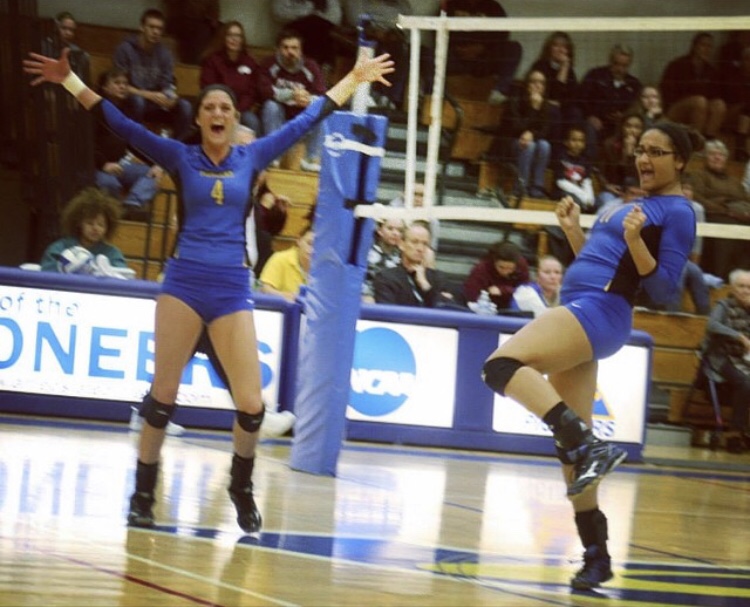
Turner explains that public performances in a culture are like social dramas, in which sporting events are a perfect example. As the chapter states (2017), the teams come together in competition, creating a breach (threat to order). As the teams play and make gains against one another, a “spirit of crisis” arises and fans take sides. Rules, officials, time-outs, team huddles, and coaching all offer moments of redressive action, as the teams and fans deal with the crisis in a variety of ways. A game normally ends with both teams shaking hands and fans from both teams possibly hanging out after the game. “These performances, then, are more than just games… they teach us about competition, collaboration, loyalty, and a host of other values important to a culture (Littlejohn, et al., 2017).
I am thankful that sports has taught me all those things and has definitely been a huge part in shaping who I am today. So here’s one of my favorite pictures of me and one of my favorite teammates that I got the pleasure of playing beside for a year because she also taught me important values that have stuck with me for the last three years… and this picture displays the support she ALWAYS gave me (love you KP)!
Littlejohn, Stephen W., et al. Theories of Human Communication. Waveland Press, Inc., 2017.







 First and foremost, I have to share this quote from chapter one that stuck out to me right off the bat: “Communication is one of those everyday activities intertwined with all of human life so completely that we sometimes overlook its pervasiveness, importance, and complexity” (Littlejohn, Foss, and Oetzel, 2017).
 Janae's Journey